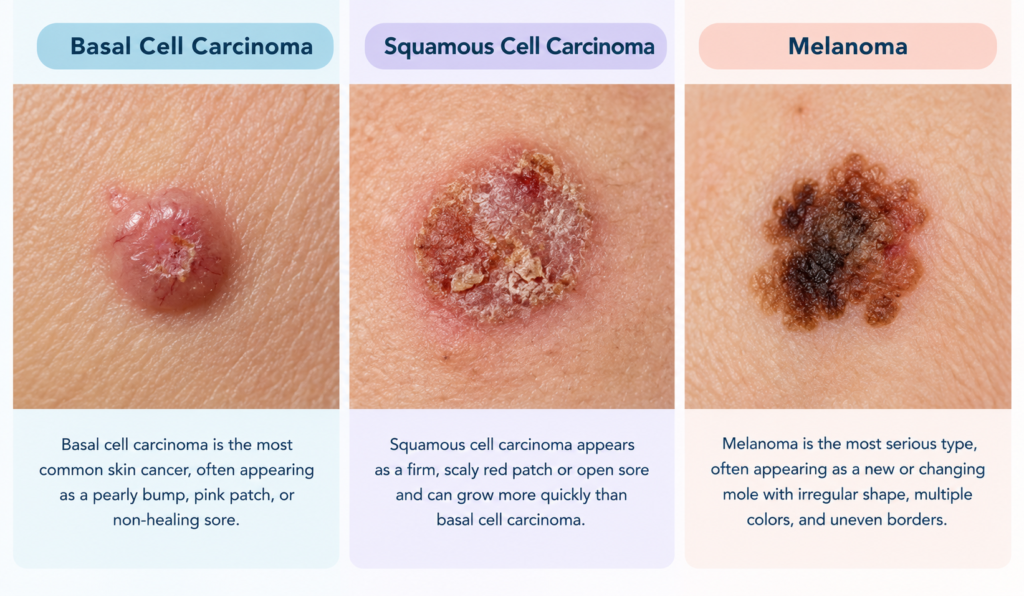
Signs of Skin Cancer You Should Know, including changing moles, unusual spots, sores, bleeding, and melanoma warning signs to watch for. Skin cancer occurs when abnormal skin cells grow in an uncontrolled way. The three most common types are basal cell carcinoma, squamous cell carcinoma, and melanoma, and they can look quite different from one another. Basal cell carcinoma may appear as a shiny or firm bump, while squamous cell carcinoma can look like a rough, scaly patch or a sore. Melanoma often involves a changing mole or unusual pigmented spot, although it can have several different appearances. Because skin cancers do not all look the same, it is important not to rely on one specific appearance when checking your skin.
What Are the Signs of Skin Cancer You Should Know?
Some of the most important warning signs include a new growth, a spot that is changing in size or appearance, a mole with an unusual shape or color, a rough or scaly patch, and a sore that does not heal or repeatedly comes back. A suspicious area may also itch, hurt, bleed, crust, become tender, or feel different from the surrounding skin. However, skin cancer can sometimes cause no noticeable discomfort at all, especially in its early stages. This means you should pay attention to visible changes even when a spot does not hurt.
A New Spot That Looks Different
A new spot on your skin is not automatically a sign of cancer, but a new or unusual mark deserves attention, especially if it continues to grow or looks noticeably different from your other moles and freckles. Melanoma can develop as a new mole-like spot or as an unusual colored area, and some skin cancers can initially resemble something harmless, such as a pimple or insect bite. If a new spot does not go away or continues to change, it is sensible to have it evaluated rather than assuming it is harmless.
A Mole That Changes Over Time
One of the most useful things you can watch for is change. A mole that begins changing in size, shape, color, or texture deserves attention, particularly when the change happens over weeks or months. A previously stable mole that suddenly becomes darker, develops several colors, grows, becomes raised, or develops an irregular edge may need professional evaluation. The important point is not simply how a mole looks today but whether it looks different from how it looked before.
The ABCDE Rule for Melanoma
The ABCDE rule is a simple way to remember some of the warning signs associated with melanoma. A stands for Asymmetry, meaning one half of a spot does not resemble the other. B stands for Border, referring to an irregular, jagged, scalloped, or poorly defined edge. C stands for Color, especially when a spot contains different shades such as brown, black, red, white, gray, or blue. D stands for Diameter, with melanomas often being larger than 6 millimeters, roughly the size of a pencil eraser, although they can be smaller. E stands for Evolving, meaning the spot is changing in size, shape, color, or overall appearance. Not every melanoma shows every ABCDE feature, so a changing or unusual spot should still be checked even if it does not meet all five signs.
A Mole With an Irregular Border
Healthy-looking moles often have relatively smooth, defined edges, while a suspicious mole may have an uneven, jagged, notched, or blurry border. The pigment may also seem to spread outward into the surrounding skin. An irregular border alone does not prove that a mole is cancerous because benign moles can also have unusual shapes, but it becomes more concerning when combined with other changes such as uneven color, growth, or asymmetry.
Uneven or Multiple Colors
Color changes can be another important clue. A mole that contains several different shades rather than one fairly consistent color may need closer attention. Concerning colors can include different shades of brown or black as well as areas of red, pink, white, gray, or blue. Some skin cancers, however, may be skin-colored, red, pink, or otherwise less obviously dark, so the absence of black or brown does not automatically rule out skin cancer.
A Sore That Does Not Heal
A sore that does not heal normally is one of the signs worth taking seriously. Basal cell carcinoma and squamous cell carcinoma can appear as sores that fail to heal, heal and then return, or repeatedly crust and bleed. It can be easy to dismiss such an area as a minor injury, especially when it is small, but a persistent sore should not be ignored simply because it does not look dramatic.
A Rough or Scaly Patch
Skin that remains rough, dry, or scaly despite normal skin care can sometimes be a warning sign, particularly when the patch continues to persist or changes over time. Squamous cell carcinoma may appear as a rough or scaly patch, while other skin conditions can produce similar changes. Because eczema, irritation, infections, sun damage, and skin cancer can sometimes resemble one another, persistent patches are best assessed by a healthcare professional rather than diagnosed from appearance alone.
A Shiny, Firm, or Raised Growth
Basal cell carcinoma can appear as a firm, round, raised growth or a shiny bump. It may be pink, red, brown, black, skin-colored, or another shade depending on the individual and the type of lesion. Some lesions may also have a central dip or resemble a scar. A growth that slowly enlarges, repeatedly bleeds, crusts, or breaks open deserves medical attention, even if it does not cause significant pain.
A Growth That Bleeds or Crusts
Occasional bleeding from a spot does not automatically mean skin cancer, particularly if you have accidentally scratched or injured it. However, repeated unexplained bleeding, crusting, or reopening can be a warning sign. Some basal cell and squamous cell carcinomas may bleed after minor irritation, while melanoma can also bleed or develop surface changes as it progresses. If the same spot repeatedly bleeds without a clear reason, it is worth having it examined.
Itching, Pain, or Tenderness
Many skin cancers do not hurt, which is why waiting for pain before seeking care is not a good strategy. Still, some suspicious spots can itch, feel tender, sting, burn, or become painful. Numbness or a pins-and-needles sensation can also occur with some skin cancers. These symptoms can have many causes, so they are not proof of cancer, but an unusual spot that changes and also becomes itchy or painful deserves attention.
Dark Lines Under a Fingernail or Toenail
Skin cancer can sometimes develop beneath or around a nail. One warning sign is a new dark brown or black vertical streak under a fingernail or toenail, especially if it changes or becomes wider. Melanoma can also appear as a darker band around the nail. This type of change can have causes other than cancer, including injury, but a new or changing pigmented streak should be professionally evaluated rather than ignored.
Check Your Palms, Soles, and Nails Too
When people think about skin cancer, they often check their face, arms, and other areas exposed to sunlight. Those areas are important, but skin cancer can occur anywhere on the skin. Melanoma may appear on the palms, soles, or beneath the nails, including in people with darker skin. For that reason, a thorough skin check should include areas that are easy to overlook, such as the bottoms of the feet, between the toes, the scalp, and the nail beds.
Skin Cancer Can Look Different on Different Skin Tones
Skin cancer does not look exactly the same on everyone. Depending on skin tone and the type of cancer, a suspicious growth may be brown, black, red, pink, white, gray, blue, or close to the person’s natural skin color. People with darker skin should also know that melanoma can occur on areas such as the palms, soles, and under the nails. Looking for change, unusual growth, persistent sores, and other differences is more useful than expecting every skin cancer to have one particular color.
Where Can Skin Cancer Appear?
Skin cancer can develop almost anywhere on the body. Common locations include the head, neck, ears, scalp, hands, arms, shoulders, chest, and back, but suspicious changes can also occur on the legs, abdomen, feet, nails, lips, and other less obvious areas. Some types are strongly associated with sun-exposed skin, but that does not mean covered areas are completely protected. A full skin check should look beyond the areas you see every day.
When Should You See a Doctor?
You should consider making an appointment with a dermatologist or other qualified healthcare professional if you notice a new or changing spot, a mole that looks different from your others, a sore that does not heal or repeatedly returns, unexplained bleeding or crusting, or a growth that continues to enlarge. It is especially important to seek medical advice when a spot is changing in several ways or simply looks unusual compared with the rest of your skin. These signs do not mean you definitely have cancer, but only a professional examination and, when necessary, testing can determine what a suspicious lesion actually is.
How Is Skin Cancer Diagnosed?
Looking at a spot or comparing it with online photographs cannot confirm skin cancer. A healthcare professional may examine the area closely and decide whether further testing is needed. If melanoma or another skin cancer is suspected, a biopsy may be performed, meaning some or all of the abnormal tissue is removed and examined in a laboratory for cancer cells. This is why professional evaluation matters when a skin change concerns you.
How to Check Your Skin at Home
Regular skin self-checks can help you notice changes that might otherwise go unnoticed. Take time to look at your entire skin surface, including your face, neck, arms, legs, back, scalp, palms, soles, and nails. A mirror can help you see difficult areas, and taking occasional photos of existing moles can make changes easier to recognize over time. You do not need to panic over every freckle or mole; the goal is to become familiar with what is normal for your skin so that a genuine change stands out.
How Can You Reduce Your Risk?
You cannot prevent every case of skin cancer, but protecting your skin from excessive ultraviolet radiation can reduce risk. Practical habits include seeking shade when the sun is strongest, wearing protective clothing and a broad-brimmed hat when appropriate, and using broad-spectrum sunscreen as directed. Avoiding indoor tanning is also important because tanning devices expose the skin to ultraviolet radiation. Skin protection is useful at every age, so it is worth making these habits part of your normal routine.
Conclusion
The most important thing to remember is that skin cancer does not have one universal appearance. A suspicious change may be a new spot, a changing mole, a rough patch, a shiny bump, a persistent sore, or a dark line beneath a nail. Some lesions itch or bleed, while others cause no symptoms at all. Learning the ABCDE warning signs of melanoma and paying attention to anything new, changing, or different can help you recognize problems earlier. If something on your skin concerns you, do not try to diagnose it from a photograph or an online checklist. Getting it checked by a qualified healthcare professional is the safest way to find out what it is.
FAQs
What is the most common early sign of skin cancer?
A new or changing spot or growth is one of the most common warning signs. It may grow, change color or shape, bleed, crust, or fail to heal. Some skin cancers can also appear as rough patches or sores that repeatedly return.
What does a cancerous mole look like?
A suspicious mole may be asymmetrical, have an irregular border, contain multiple colors, become larger, or change over time. The ABCDE rule can help you recognize these warning signs, but not every melanoma shows all five features.
Can skin cancer be painless?
Yes. Early skin cancer can be painless, and some people have no symptoms other than a visible change on the skin. This is why a new or changing spot should not be ignored simply because it does not hurt.
Can a sore that does not heal be skin cancer?
Yes. A sore that does not heal, repeatedly crusts or bleeds, or heals and then returns can be a warning sign of basal cell carcinoma or squamous cell carcinoma. Other skin conditions can cause persistent sores too, so professional evaluation is needed for a diagnosis.
Can skin cancer appear under a fingernail?
Yes. Melanoma can develop under or around a fingernail or toenail and may appear as a new dark vertical streak or band of pigment. A new or changing dark line should be checked by a healthcare professional.
Read also: What Are the Key Signs of Stress Affecting Mental Health?
Pingback: Difference Between Heart Attack and Cardiac Arrest